 Little Pip
Choosing Bottles and Pacifiers
Glass or plastic, which flow rate, and when to offer a pacifier? What to look for when buying bottles and pacifiers, plus cleaning and safe-use rules.
Standing in front of the bottle and pacifier shelf in the baby aisle, the options can seem endless: different shapes, colors, “anti-colic” claims and dozens of bottle nipples numbered by age. In fact, a few basic criteria are enough for a good choice: a safe material, a flow that matches how fast your baby sucks, a design that's easy to clean, and a pacifier that is the right size and made in one piece. If you're breastfeeding, you may never need a bottle, or you may need one much later; so starting with one or two bottles and seeing what your baby accepts is smarter than buying a shelf full of products.
Bottle materials: glass, plastic, silicone
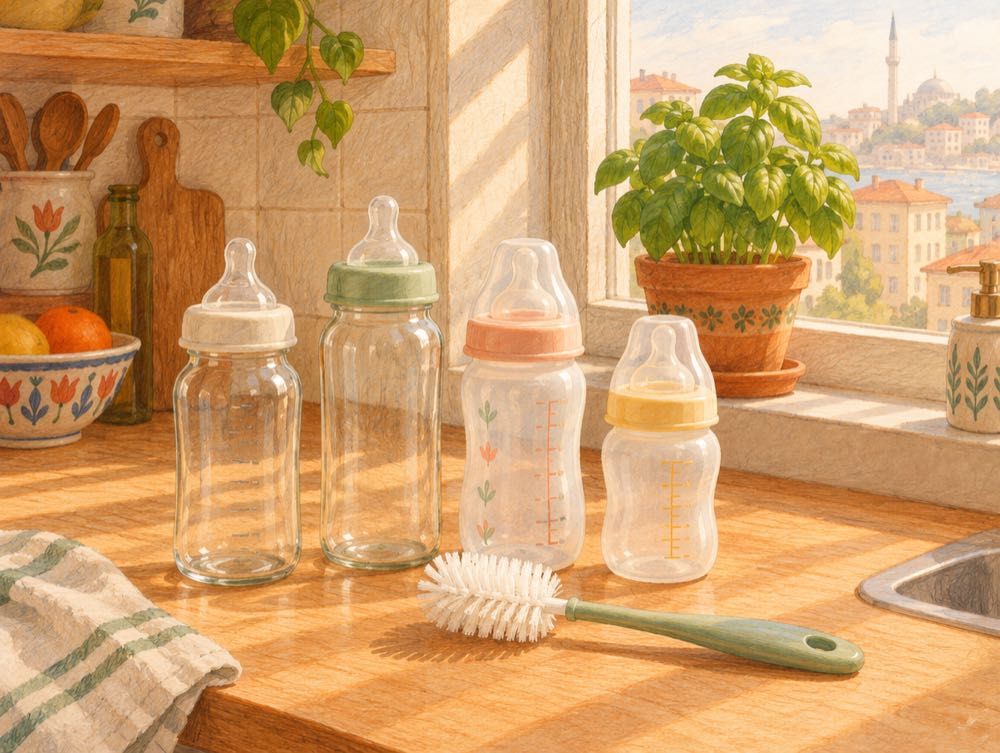
Glass bottles don't scratch, don't hold odors and are easy to clean; but they are heavy and can break if dropped. Choosing heat-resistant glass and using a protective sleeve reduces this risk. Plastic bottles, such as polypropylene ones, are the most common option because they're light and unbreakable. BPA has been banned in baby bottles in the European Union for years; still, seeing it clearly stated on the label that the bottle is BPA-free is a good sign. A plastic bottle should be replaced when it gets scratched, cloudy or cracked. Silicone bottles are soft and light, and some babies like holding them; when cleaning, make sure no residue is left on the inside. Whichever material you choose, look for markings showing that the product is suitable for food contact and complies with European safety standards.
Bottle nipples: flow rate and “anti-colic” claims
Bottle nipples are usually numbered by age or flow rate. Starting newborns on the slowest flow is a good rule; the age label is only a guide, and the real measure is your baby. If the flow is too fast, your baby coughs, struggles to swallow, lets milk escape from the corners of their mouth, or finishes very quickly and becomes fussy. If the flow is too slow, they suck for a long time and get tired or frustrated, or the nipple collapses inward. Many bottles offer a valve or venting system to reduce air swallowing. Some families say they notice a difference, but scientific evidence that this prevents colic is limited. If your baby is comfortable, you don't need to switch to an expensive system; feeding them upright, with breaks and burping, often makes more of a difference.
Cleaning, sterilizing and when to replace
The bottle, nipple and cap should be cleaned with hot soapy water and a bottle brush after every use, then rinsed. Health authorities recommend sterilizing feeding equipment for at least the first year, especially for babies fed formula. Whichever option you use, boiling, a steam sterilizer or a cold-water sterilizing solution, follow the times and methods in the product's instructions. Before each use, hold nipples up to the light to check them and pull gently to test that they're sturdy. A nipple that has thinned, cracked, become sticky, changed color or swollen should be thrown away immediately, because a small piece that breaks off poses a choking risk. Apart from this, replacing them at the intervals the manufacturer recommends is also a good habit.

Pacifiers: safe design and the right size
When choosing a pacifier, the most important point is safety. Choose a model that is preferably one piece, or whose parts are firmly joined and don't come apart easily. The mouth shield should be wide enough that it can't go into your baby's mouth and should have ventilation holes so it doesn't block breathing. Pacifiers are usually sized by age; use the size that's right for your baby's age. In Europe there is a separate safety standard for pacifiers; seeing EN 1400 or conformity markings on the package is a good sign. Check it every time before use by pulling on the nipple; throw it away if there is a crack, hole or stickiness. Silicone nipples are more durable and odorless, while rubber nipples are softer but wear out faster. No clear health difference between orthodontic and regular nipples has been proven; it's enough to use whichever one your baby accepts.
Pacifiers and breastfeeding, safe-use rules
If you're breastfeeding, a common recommendation is to wait to offer a pacifier until breastfeeding is well established, usually the first few weeks. The American Academy of Pediatrics states that offering a pacifier when putting your baby down to sleep may reduce the risk of sudden infant death; but if your baby doesn't want it, it shouldn't be forced, and if it falls out during sleep, you don't need to put it back in. Never tie a pacifier to your baby's neck, the crib or their clothes with a string or ribbon; there is a risk of strangulation. If you use a pacifier clip, choose a short, safe model that attaches firmly to the pacifier and is sold together with it, and take it off during sleep. Don't dip the pacifier in honey, sugar or anything sweet; honey must not be given in any form before one year of age, and sweeteners cause tooth decay. If you think pacifier use is linked to an ear infection, sores in the mouth or a feeding problem, talk to your pediatrician.
In-store checklist
Is the material suitable for food contact, and does it state that it's BPA-free and complies with European safety standards? Does the packaging show conformity information such as the CE or UKCA mark? Does the bottle have a wide neck, does a brush fit inside easily, and how many parts does it have? Are spare nipples and caps easy to find? Is the flow slow enough for a newborn? Is the pacifier one piece, does the mouth shield have ventilation holes, and is the size right for your baby's age? Extras you don't need: buying lots of bottles of the same type before the birth, stocking pacifier sets for every age, light-up or musical pacifiers, and decorative pacifier chains. A big set bought before you've seen which nipple your baby likes often ends up sitting in a drawer.
Sources (4)
- How to make up baby formula, NHS (England)
- Sleep-Related Infant Deaths: Updated 2022 Recommendations for Reducing Infant Deaths in the Sleep Environment, American Academy of Pediatrics (AAP) · 2022
- Formula feeding, American Academy of Pediatrics (AAP) · HealthyChildren.org
Sources last reviewed: October 2026. This article was written for Little Pip and is based on information published by these organizations.