 Little Pip
Choosing a Crib and Mattress
Safe sleep starts with a good crib and a firm mattress that fits snugly. Standards, slat spacing, bedside cribs, bassinets and used mattresses.
In the first months, your baby will spend most of the day asleep, so the place where they sleep is one of the most important things in your home. A safe sleep space is actually very simple: a sturdy crib, a firm, flat mattress that fits it snugly, a tightly fitted sheet, and nothing else. Health authorities recommend that for the first six months, babies sleep on their back in their parents' room but in their own sleep space. In this guide you'll find what to look for when buying a crib and mattress, which items are unnecessary and risky, and the limits of options such as bassinets and bedside cribs. You can also read all the safe sleep rules in the safe sleep article in the Discover tab.
Crib: standards and slat spacing
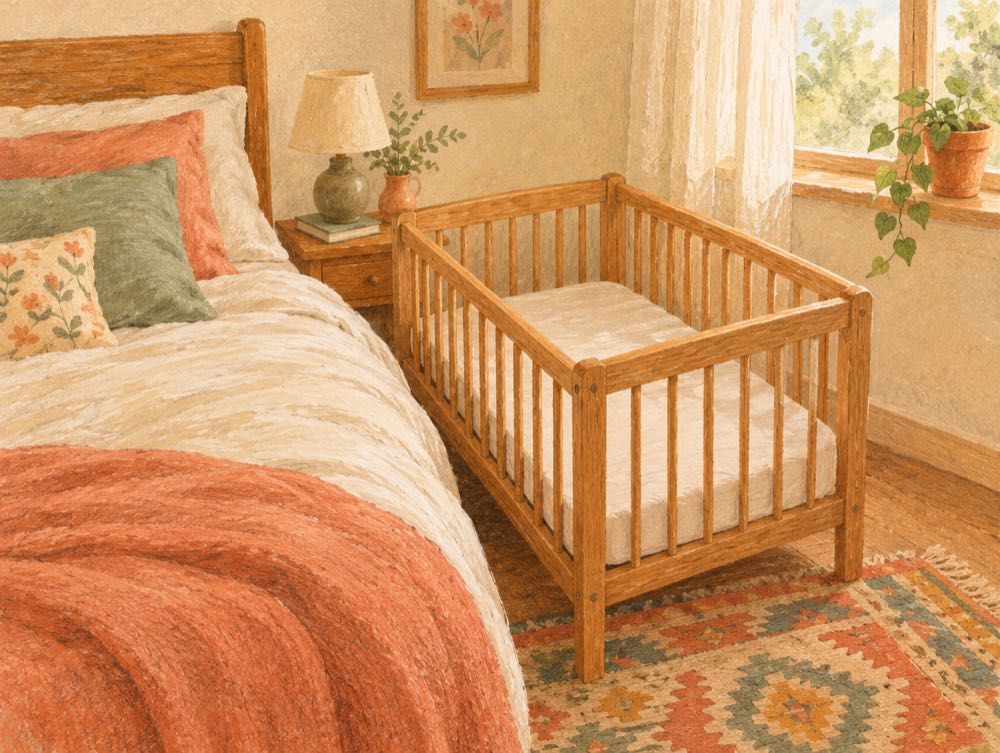
In Europe, there is the EN 716 standard for household cribs, and it defines many measurements, from slat spacing to side height. The gap between slats should be between about 4.5 and 6.5 centimeters; if it's wider, your baby's head or body could get trapped. The crib's corner posts should not be tall, and the headboard and footboard should not have openings or decorative cutouts that a baby's arm or head could fit into. All screws should be tight, corners smooth and the paint safe for children. Drop-side models have been banned in some countries because the detachable side poses an entrapment risk. If you use a rocking crib, it should have a lock to stop the rocking, and it should be kept locked while your baby sleeps.
Mattress: firm, flat and a snug fit
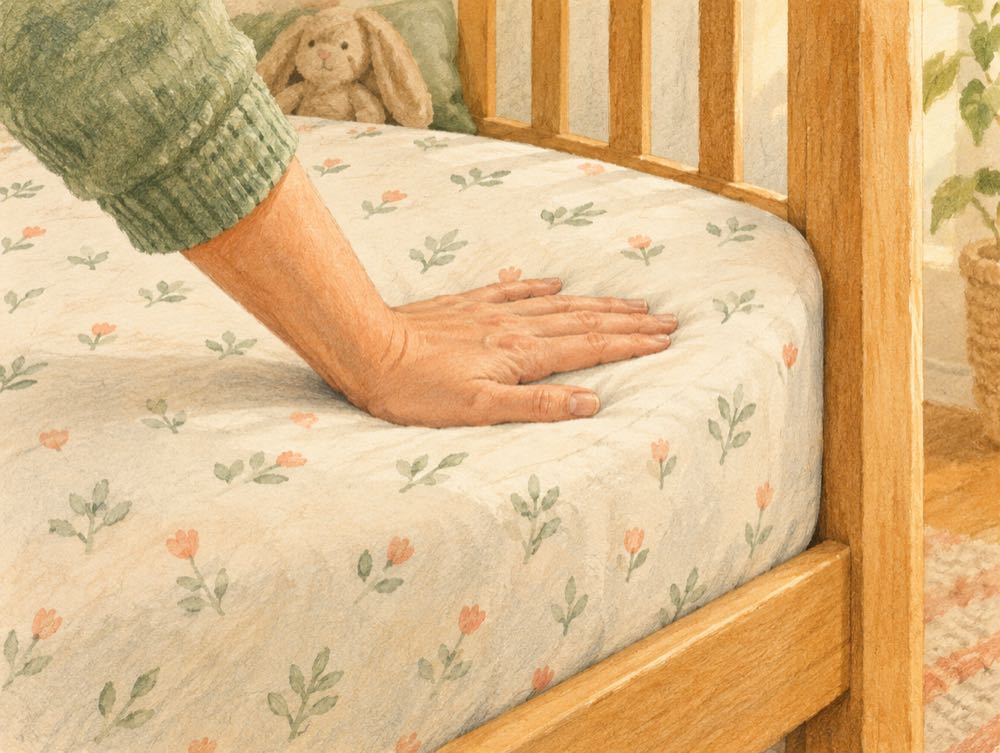
A baby mattress should be firm and flat. When you press it with your hand, it should spring back quickly and not mold to your baby's face. Soft mattresses, or ones that sag in the middle or are inclined, are not suitable. In Europe, there is the EN 16890 standard for children's mattresses; seeing it on the label is a good sign. The mattress must fit the crib snugly: If more than two fingers fit between the side of the crib and the mattress, the mattress is too small and your baby could get trapped in that gap. A waterproof, wipeable cover makes cleaning easier. Choose the mattress sold with the crib, or one in the size the manufacturer recommends for that crib. Don't lay an extra soft pad, feather bed or comforter on top of the mattress; the sheet should also be an elastic fitted sheet that sits taut on the mattress.
What shouldn't be in the crib
Your baby's sleep space should not contain pillows, comforters, thick blankets, stuffed toys, crib bumpers, sleep positioners or wedge pillows. Crib bumpers may look decorative, but they're not recommended because they carry a risk of suffocation and entrapment; the sale of padded crib bumpers has been banned in the US. If you're worried your baby will be cold, use a sleep sack suited to the season; if you use a blanket, it should be thin, your baby should be placed with their feet touching the foot of the crib, and the blanket should be tucked firmly under the mattress at armpit level. Place the crib away from curtain cords, blind cords, heaters and windows. The baby monitor cable should also be kept away from the crib. The emptier the sleep space, the safer it is.
Bedside cribs, bassinets and play yards
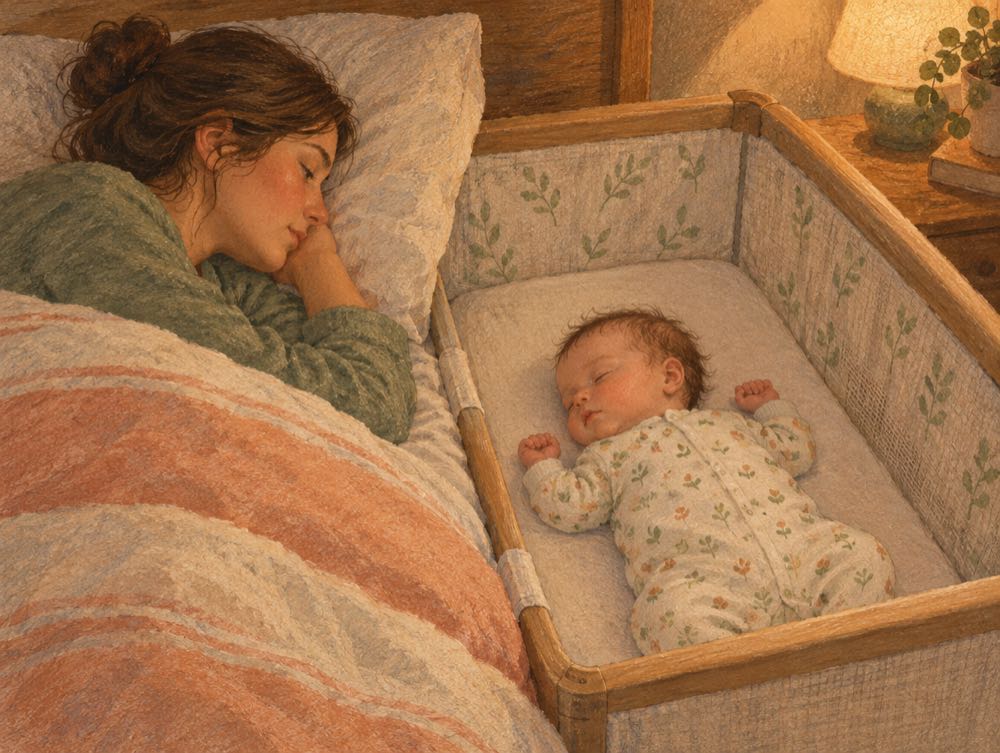
Bedside cribs attach to the side of the parents' bed and keep your baby close but on a separate surface. If you choose one, look for a model with straps that attach firmly to the bed, that leaves no gap between the two mattresses and that can be set level with the height of your own mattress. When it isn't attached, always raise the side. Portable bassinets are practical in the first weeks; but you should stop using one when your baby starts to roll over, sit up or push themselves up, or reaches the weight limit stated by the manufacturer. Put the bassinet on the floor or on a sturdy table, never on soft surfaces like a sofa or bed. In play yards, use only the play yard's own thin mattress; putting an extra mattress on top can create dangerous gaps.
Height adjustment and used mattresses
Many cribs have a mattress base that can be adjusted to several heights. In the first months, the top position makes it easier to lift your baby; but you need to lower the base to the bottom position before your baby starts to sit up or pull up to stand, otherwise they could fall out of the crib. When the side height starts to fall below your baby's chest level, it's nearly time to move to a big bed. If you're buying a used crib, make sure all the parts and screws are there and that the wood has no cracks or breaks; don't replace a missing part with a different one. For the mattress, choose a new one if possible. If you use a used mattress, it must be completely firm, flat, dry, clean and free of tears, have a waterproof cover and fit the crib snugly.
In-store checklist
Does the crib meet EN 716 or a European safety standard, and are the assembly instructions in English? Is the slat spacing between about 4.5 and 6.5 centimeters, and are the sides high enough? Are there corner posts, decorative cutouts or protrusions? Can the base height be adjusted? Is the mattress firm, does it spring back quickly when pressed, and does it fit the crib without leaving a gap of more than two fingers? Is the cover washable and waterproof? Does the fitted sheet size match the mattress? Extras you don't need: crib bumpers, pillow and comforter sets, sleep positioners, wedge pillows, baby nests placed inside the crib and big stuffed toys. These look nice, but they don't belong in the sleep space.
Sources (4)
- Safer sleep information, The Lullaby Trust
- Sleep-Related Infant Deaths: Updated 2022 Recommendations for Reducing Infant Deaths in the Sleep Environment, American Academy of Pediatrics (AAP) · 2022
- Sudden infant death syndrome (SIDS), NHS (England)
Sources last reviewed: October 2026. This article was written for Little Pip and is based on information published by these organizations.