 Little Pip
First-Trimester, Triple and Quad Screening Tests
When are screening tests done, what do they measure and what do the results mean? Understanding the difference between screening and diagnosis.
Screening tests in pregnancy help estimate the chance that your baby has certain chromosome differences, such as Down syndrome, or open neural tube defects. The most important point is this: these tests don't diagnose anything; they only calculate a risk. So a high-risk result doesn't mean your baby definitely has a problem, and a low-risk result doesn't rule everything out completely. Having these tests is optional, and you decide together with your doctor which test is right for you.
The first-trimester (combined) screen
This screen, sometimes called the double test, is done between week 11 and the start of week 14. Two substances in the mother's blood, PAPP-A and free beta hCG, are measured, and at the same time the thickness at the back of the baby's neck (nuchal translucency) is checked on ultrasound. These results are assessed with special software together with the mother's age, weight and week of pregnancy to calculate a risk ratio. Because it's done early and combined with the ultrasound finding, this is a very valuable screen. You don't need to fast for the blood draw.

The triple and quad tests
If you missed the first-trimester screen or your doctor wants more information, a triple or quad screen can be done between weeks 15 and 22 of pregnancy. The most accurate result usually comes between weeks 16 and 18. The triple test measures AFP, hCG and estriol; the quad test also measures inhibin A. Besides chromosome differences, these tests also give information about neural tube defects such as spina bifida. Getting the week of pregnancy right is very important for reliable results.
Cell-free DNA testing
Cell-free DNA testing, which can be done from week 10 of pregnancy, looks at DNA fragments circulating in the mother's blood that come from the placenta. It's much more sensitive than classic screens at picking up certain chromosome differences, especially Down syndrome. Still, it's a screening test; a high-risk result must always be confirmed with a diagnostic test. It may not be offered everywhere and may cost extra. You can talk to your doctor about whether this test is right for you, and about its advantages and limits.
If your result is high risk
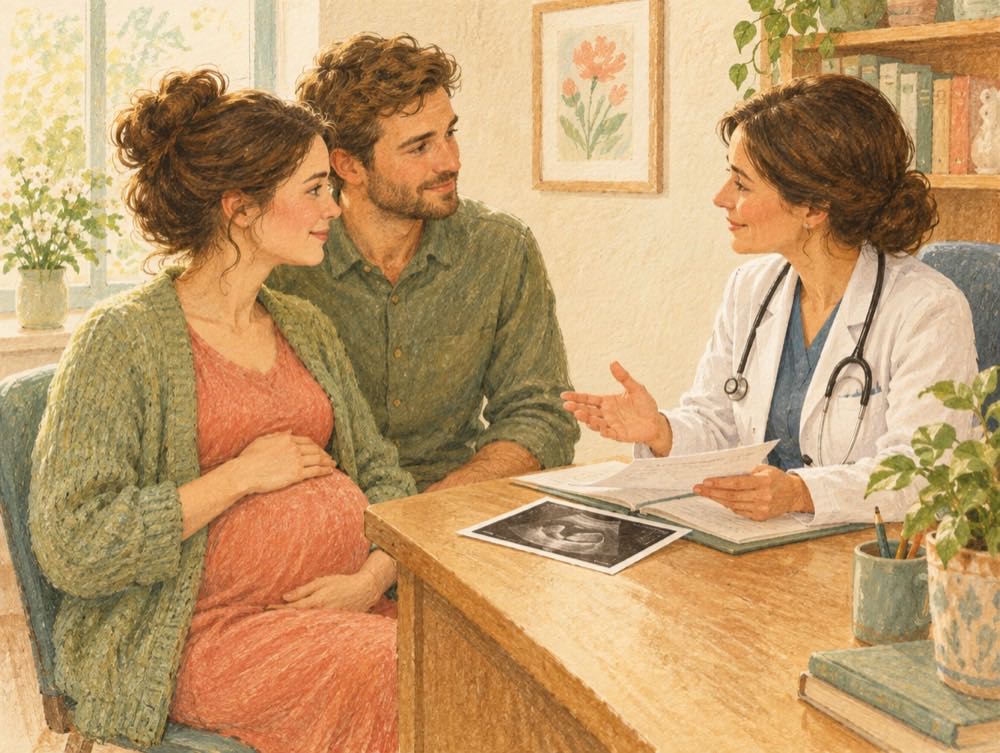
Getting a high-risk result can be very frightening, but first take a deep breath: most women who get this result have a healthy baby. Your doctor will explain the result in detail and, if needed, describe options such as a more detailed ultrasound, cell-free DNA testing, or chorionic villus sampling (CVS) or amniocentesis for a definite diagnosis. You can make these decisions without rushing, asking your questions and, if needed, talking to a genetic counselor. Whichever path you choose, it's your decision and your family's.
Sources (3)
- Screening for Fetal Chromosomal Abnormalities (Practice Bulletin No. 226), ACOG · 2020
- Antenatal care (NG201), NICE · 2021
Sources last reviewed: October 2026. This article was written for Little Pip and is based on information published by these organizations.