 Little Pip
What to Do When Your Baby Has a Fever
When is it a fever, how do you measure it, how can you comfort your baby at home, and when should you get help without waiting? A step-by-step guide.
Take a deep breath. Touching your baby's warm forehead or seeing a high number on the thermometer can be frightening. A fever is often a sign that the body is fighting an infection, and it is not an illness in itself. The most common cause of fever in babies is a passing infection like a cold. Still, in babies, especially in the first months, fever should be taken seriously. Below you'll find what to do step by step, and when you should get help without waiting. Remember: Your baby's overall condition often tells you more than the number on the thermometer.
When is it a fever?
In babies, body temperature is usually between 36 and 37 °C and can vary a little during the day. 38 °C or higher is considered a fever. Your baby feeling warm does not by itself mean they have a fever; if you suspect a fever, always measure it with a thermometer. Along with a fever, you may see flushed cheeks, cold hands and feet, shivering, fussiness, poor appetite and sleeping more than usual. How high the fever is doesn't always show how serious the illness is; your baby's overall condition is at least as important as the number on the thermometer. The same number means different things in a baby who is playing, smiling and feeding than in a baby who is floppy and uninterested.
How do you measure it?
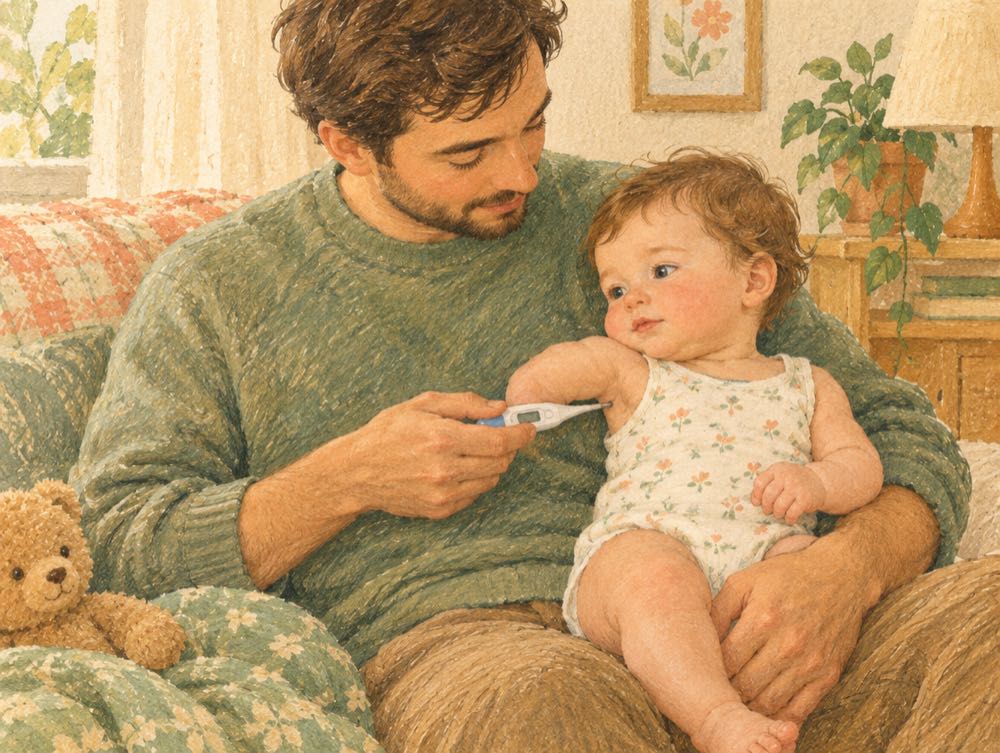
- Measuring under the arm with a digital thermometer is the practical and safe method recommended for babies.
- Place the tip of the thermometer in the middle of the armpit, hold your baby's arm gently pressed against their body, and wait for the beep.
- Remove thick clothing before measuring. If your baby has just come out of the bath or from being tightly bundled, wait a few minutes.
- Ear thermometers can be used in older babies; they may not give accurate results in newborns.
- Forehead strips are not reliable; don't use a glass mercury thermometer.
- Write down the reading and the time; a few readings will be very useful when you talk to the doctor.
If your doctor has given you different advice about using a thermometer, follow it.
Why does age matter?
- Baby younger than three months: A fever of 38 °C or higher means going to a doctor or emergency department without waiting, even if your baby seems well. At this age the immune system is still developing, and serious infections may not show clear symptoms at first.
- Between three and six months: For a fever of 39 °C or higher, see a doctor the same day.
- Baby older than six months: If their overall condition is good and they're feeding and playing, you can watch them at home. But if the fever lasts five days or longer, if your baby seems listless, or if you're worried, see a doctor.
For babies born early or with a known health condition, your doctor may have given you a different threshold; follow it.
Comforting your baby at home
- Fluids: Breastfeed your baby often or give their usual formula. Fever increases fluid loss; keep track of wet diapers.
- Dress lightly: Don't dress your baby in layers or bundle them tightly, but don't leave them completely naked either. A thin cotton outfit and a cool but not cold room are enough.
- Rest: If your baby wants to sleep, let them sleep; check on them often while they sleep, and put them on their back.
- Don't: Don't use cold baths, cold wet towels, or rubbing with alcohol or vinegar. These can make your baby even more uncomfortable by causing shivering; alcohol can be absorbed through the skin and cause poisoning.
- Check on your baby a few times during the night too; if things get worse, get help without waiting.
- If your baby goes to daycare, keep them home until the fever has passed.
Fever-reducing medicines
Fever reducers don't treat the cause of the fever; the goal is to make your baby comfortable. If your baby has a fever but is comfortable, it may not be necessary to give medicine just to bring the number down.
- Before giving your baby any fever reducer, especially in the first months, always talk to your doctor or pharmacist.
- In babies, the dose is based on weight. Find out from your doctor or pharmacist which medicine to give, how much and how often, and use the measuring device that comes with the medicine.
- Don't give different medicines one after another or together on your own.
- Never give medicines containing aspirin to babies and children.
- Antibiotics are used only when a doctor decides they're needed; not every fever needs antibiotics.
- Fever reducers have not been shown to prevent febrile seizures.
Right away: the doctor or your local emergency number (911 in the US, 999 in the UK)
Call your local emergency number right away if:
- Your baby is having trouble breathing, grunting, their chest is pulling in, or their lips are turning blue.
- Your baby is floppy, unresponsive or very hard to wake.
- Your baby is having a seizure.
- There is a rash that doesn't fade when pressed.
See a doctor or go to an emergency department without waiting if:
- A baby younger than three months has a fever of 38 °C or higher.
- A baby between three and six months has a fever of 39 °C or higher.
- The crying is high-pitched, weak or different from usual; the neck is stiff or the soft spot (fontanelle) is bulging.
- Your baby refuses to feed, has fewer wet diapers or shows signs of dehydration.
- The fever lasts five days or longer.
If you're worried, talk to your doctor even if it's not on this list.
Sources (4)
- Fever in children, NHS (England)
- Fever in under 5s: assessment and initial management (NG143), NICE · 2019
- Fever, American Academy of Pediatrics (AAP) · HealthyChildren.org
Sources last reviewed: October 2026. This article was written for Little Pip and is based on information published by these organizations.